Download
Abstract
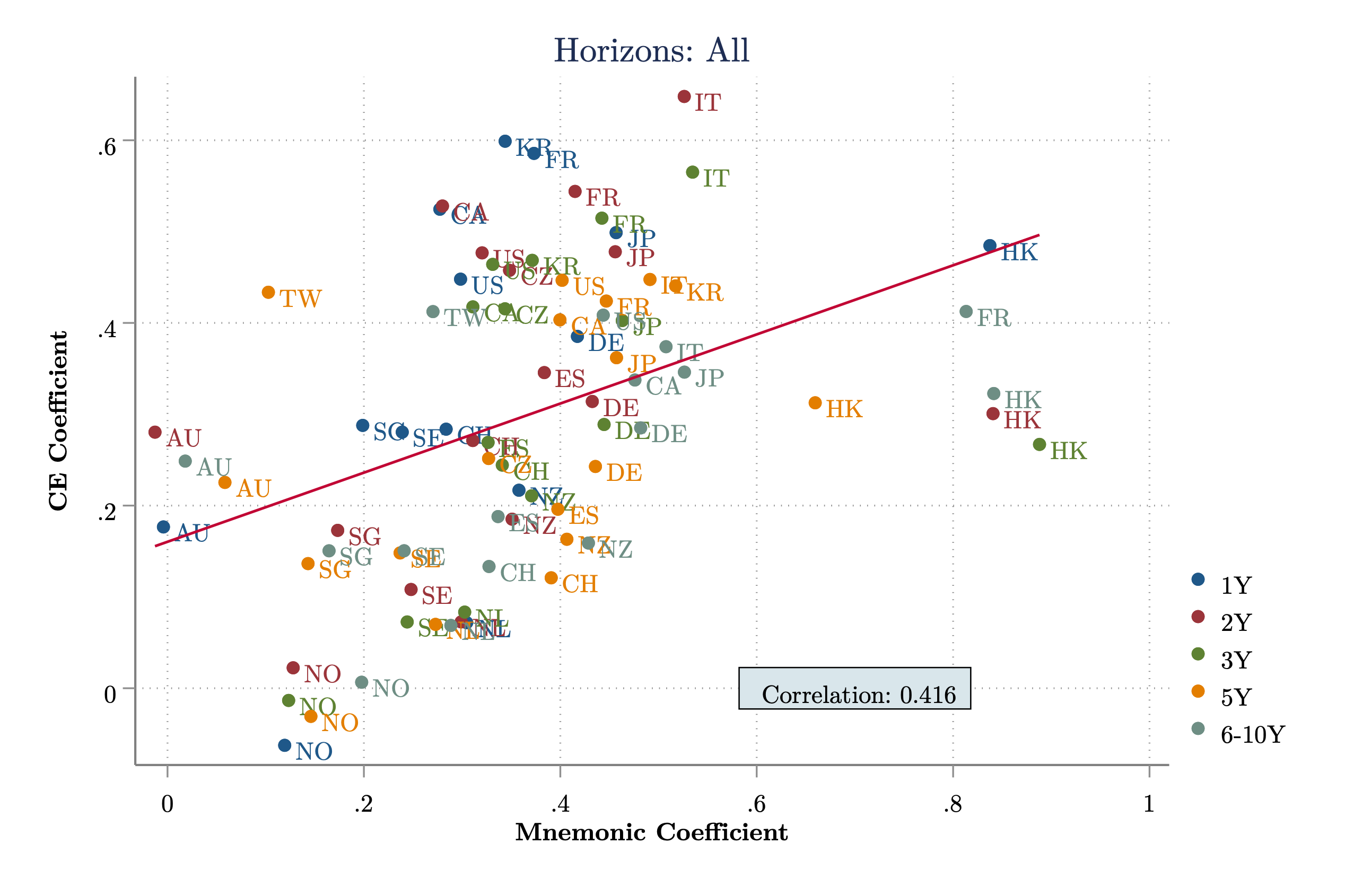
We study biases in inflation forecasts and their macroeconomic effects through interest rates. Across 18 advanced economies over 1989-2022, we find that consensus inflation forecasts mildly underreact at short horizons but sharply overreact at long horizons. These biases predict ex-post real bond returns, exhibiting a strength that varies across countries. To explain these facts, which challenge existing theories, we offer a new model in which beliefs overweight past episodes that are salient in memory. The model endogenizes under- and over-reaction based on the historical volatility and persistence of inflation, explaining cross-horizon and cross-country variation in biases and return predictability. In general equilibrium, due to memory, a positive inflation shock causes a sizable and persistent future redistribution of wealth from borrowers to lenders.
Correlation between CE and Mnemonic coefficients across horizons